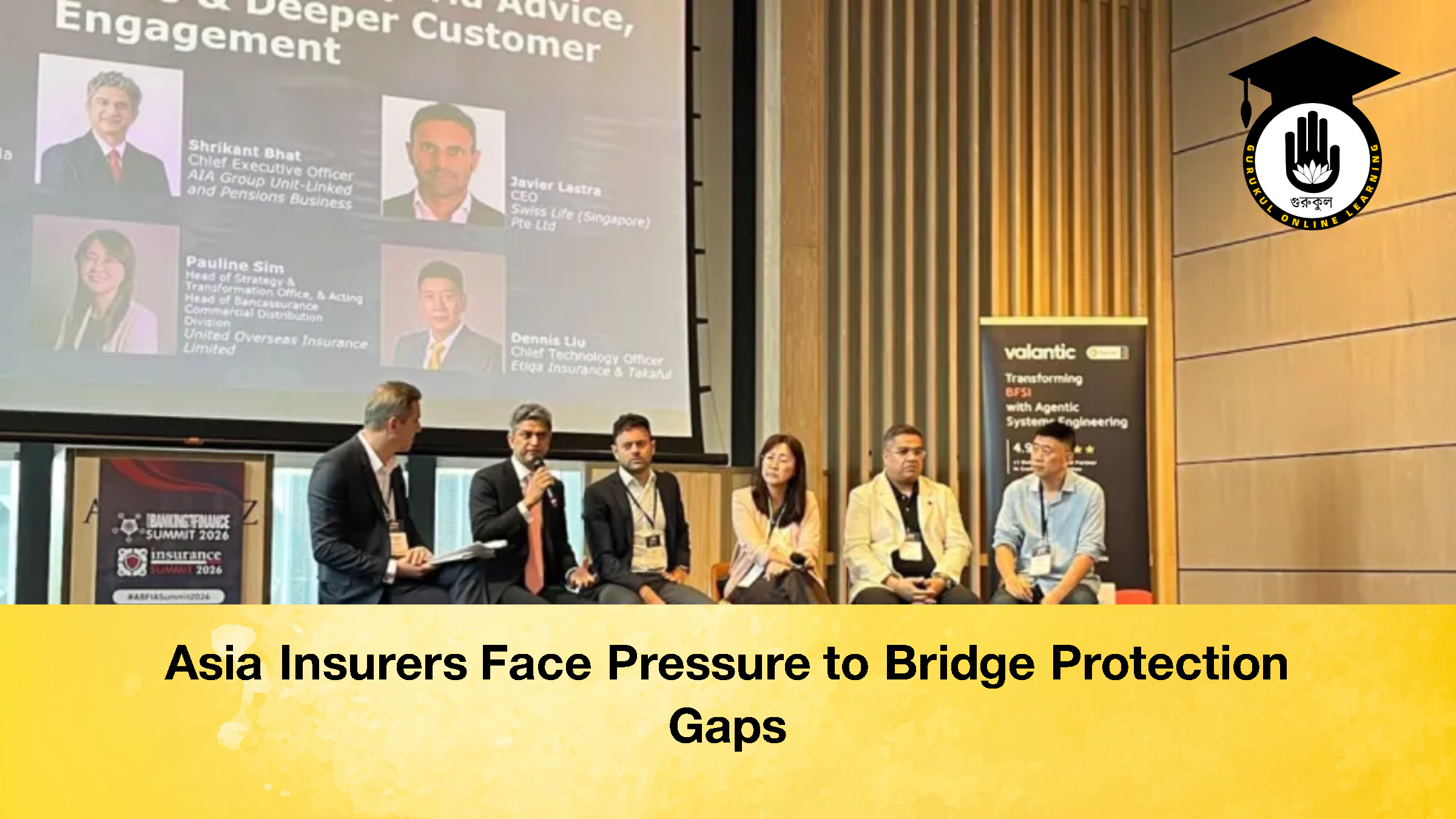
Asia’s insurance industry is under growing pressure to redefine its purpose as ageing populations, widening protection gaps and rapid advances in artificial intelligence (AI) reshape consumer expectations. Industry leaders say insurers that remain focused solely on selling policies risk losing relevance unless they evolve into trusted partners capable of delivering personalised financial planning, retirement solutions and healthcare support.
The changing landscape dominated discussions at the Asian Banking & Finance and Insurance Asia Summit held in Singapore on 1 July, where senior executives from leading insurers agreed that the industry’s future depends on creating meaningful long-term outcomes for customers rather than concentrating on individual products.
Shrikant Bhat, Chief Executive Officer of AIA Group’s Unit-Linked and Pensions Business, said the definition of customer value has shifted significantly. Rather than judging insurers by the breadth of their product offerings, customers increasingly expect guidance that helps them navigate longer life expectancy, rising healthcare costs and retirement planning.
“Customers perceive value from a point of view of how well we are addressing their concerns, and longevity is probably one of the top concerns for customers today,” Bhat told delegates.
He said longer life expectancy should be viewed as an opportunity rather than simply a financial challenge. Customers want investment solutions that can provide sustainable retirement income, alongside healthcare protection that enables them to maintain their quality of life well into old age.
“The concern for customers is how they harness the longevity dividend. They obviously need financial assets that help them live a better lifestyle, they’re obviously thinking about health plans, healthcare as they age, and whether the adequacy of that. That’s where the value creation for customers is pretty high,” he said.
The demographic trends discussed at the summit illustrate why insurers are reassessing their long-term strategies. Laurent Doucet, Partner for Insurance Asia at Roland Berger and moderator of the panel discussion, noted that Singapore’s old-age dependency ratio is projected to rise from around 20 per cent today to approximately 40 per cent by 2050. Japan’s ratio is expected to reach about 75 per cent, whilst Hong Kong’s could approach 100 per cent over the same period.
These projections suggest that a shrinking working-age population will increasingly be required to support a growing elderly population, placing additional strain on public finances, pension systems and healthcare services. As a result, insurers are expected to play a much larger role in helping individuals prepare financially for retirement and manage rising medical expenses.
Despite Singapore’s strong economic performance, industry leaders argued that wealth alone does not guarantee adequate financial protection.
Akhil Doegar, Group Head of Distribution at Singlife, highlighted what he described as a striking contradiction. Singapore ranks among the world’s wealthiest economies, with gross domestic product per capita estimated at S$85,000 (US$65,555.06), whilst households save around 36 per cent of their income. Even so, the country continues to experience significant insurance protection and critical illness coverage gaps.
“If we are so rich, how come we are so underprotected?” Doegar asked.
He argued that insurers have traditionally concentrated on selling products instead of addressing customers’ broader financial needs throughout different stages of life. According to Doegar, consumers are seeking partners who can help them manage cash flow, financial risks and long-term planning rather than simply purchasing insurance policies.
Singapore’s life insurance market nevertheless continued to post strong growth. The Life Insurance Association, Singapore reported that total weighted new business premiums reached S$6.53 billion (US$5.2 billion) for the full year, representing an increase of 11.3 per cent compared with 2024.
Growth was driven largely by stronger annual premium sales. During the fourth quarter alone, weighted new business premiums increased by 13 per cent compared with the same period a year earlier.
Investment-linked products remained the largest contributor to new business, accounting for 44 per cent of total weighted new business premiums in 2025. While these figures reflect healthy demand for insurance products with investment features, panellists cautioned that commercial growth should not distract insurers from addressing persistent protection and retirement gaps.
Artificial intelligence emerged as another central topic during the discussions. Although executives agreed that AI will reshape the insurance industry, they were equally clear that technology should strengthen, rather than replace, the role of professional advisers.
Javier Lastra, Chief Executive Officer of Swiss Life (Singapore) Pte Ltd, said trust remains the industry’s greatest competitive advantage.
“The future is more human advice enriched by artificial intelligence,” Lastra said, adding that clients routinely share highly personal and sensitive financial information with advisers, making trust fundamental to every customer relationship.
Pauline Sim, Head of the Strategy & Transformation Office and Acting Head of Bancassurance at United Overseas Insurance Limited, said insurers also face the challenge of balancing customer convenience with operational requirements and data security.
She explained that delivering customer-centric services often requires careful consideration of regulatory obligations, internal processes and cybersecurity. Maintaining strong safeguards is essential if customers are to remain confident that their personal information will be protected.
Dennis Liu, Chief Technology Officer of Etiqa Insurance & Takaful, identified fragmented data as one of the industry’s most significant operational challenges.
“We have a lot of data everywhere, but the very challenge is we don’t use data effectively,” Liu said.
He argued that centralising customer information would allow insurers to deliver more relevant services whilst improving efficiency through automation. Lower operating costs could ultimately translate into greater value for policyholders.
Etiqa has already introduced several AI-powered services, including automated travel delay claims, proactive customer outreach following fire incidents and crash detection technology that initiates claims support without waiting for motorists to report accidents.
Looking ahead, industry executives agreed that insurers will be judged increasingly on their ability to improve customers’ financial wellbeing rather than on the complexity of their products.
Bhat said AIA is placing greater emphasis on retirement income, wealth transfer and measurable customer outcomes, with technology helping to simplify insurance solutions for both advisers and clients.
“We deliver outcomes. We don’t focus so much on how we do it,” he said.
Doegar echoed that view, arguing that the industry’s long-term growth depends on addressing Singapore’s protection and retirement shortfalls rather than pursuing short-term commercial objectives.
“We have one job to close the protection and retirement gap in Singapore. If we stick to that path, we will naturally grow by doing the right thing,” he said.