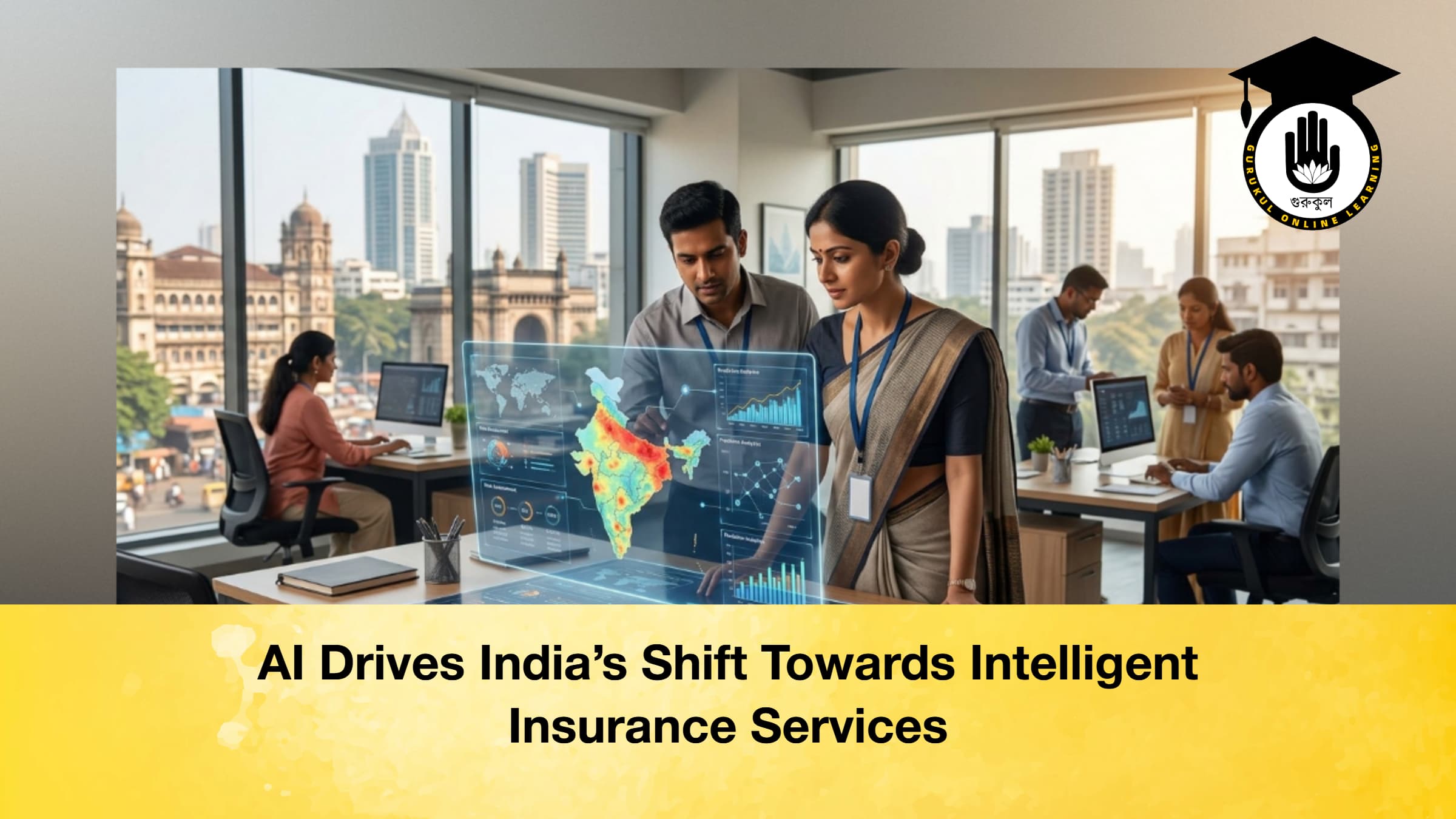
Artificial intelligence is transforming India’s insurance industry, taking the sector beyond basic digital services towards a more intelligent, data-driven operating model. From assessing risks and calculating premiums to detecting fraud, processing claims and improving customer engagement, AI is increasingly influencing how insurers make decisions and deliver services.
At HDFC ERGO General Insurance, the transition has become an important part of the company’s business and technology strategy. Sriram Naganathan, President and Chief Technology Officer of HDFC ERGO General Insurance, believes technology is moving beyond its traditional role as a support function to become a strategic element of insurance operations.
For years, technological progress in the insurance sector was measured largely through operational efficiency, system reliability, processing speed and the digitisation of existing procedures. Advances in artificial intelligence, machine learning, generative AI and agentic AI are changing that perspective. Technology is now helping insurers reconsider how they assess risks, develop products, set prices and respond to policyholders.
Insurance is fundamentally a data-driven business. Insurers must evaluate uncertainty, estimate potential losses and determine appropriate coverage and premiums. Their ability to interpret information accurately can influence financial performance, operational efficiency and customer confidence. AI offers new ways to analyse this information, identify patterns and support more informed decisions.
From digital insurance to intelligent services
HDFC ERGO has been using conventional AI and machine learning for several years in areas such as underwriting, pricing, fraud detection and claims assessment. The company is now extending these capabilities through generative AI and AI agents, which can help interpret information, respond to queries and carry out defined tasks.
According to Naganathan, approximately 95 per cent of the company’s insurance policies are issued digitally, while around 88 per cent of service interactions take place through digital channels. Nearly 10 per cent of those interactions are AI-led, indicating that intelligent systems are becoming an increasingly visible part of customer service.
The company’s Here application ecosystem illustrates this shift. Naganathan said the platform had recorded more than 12 million downloads, with a substantial proportion coming from individuals who were not existing customers.
One of its features, Know Your Policy, uses generative AI to explain insurance policies in simpler language. Instead of having to interpret lengthy documents filled with technical terminology, customers can ask questions in everyday language and receive explanations about coverage, payable benefits and exclusions.
Insurance policies frequently contain complex conditions that can be difficult for customers to understand. Misinterpretation can lead to confusion about what a policy covers, which expenses are eligible and when exclusions apply. AI-powered explanations can make this information more accessible, helping customers understand their existing protection before they need to make a claim.
Such tools do not change the contractual terms of an insurance policy. Their value lies in making the relevant information easier to find and understand, provided that the explanations accurately reflect the policy wording.
AI supports human judgement
Although automation is becoming more prominent, HDFC ERGO is not treating AI as a complete substitute for human professionals. Its approach centres on using technology to strengthen decision-making while retaining human involvement in cases that require experience, contextual understanding or sensitivity.
Straightforward, low-value claims may be suitable for a greater degree of automation because they can often be assessed against established rules and predictable criteria. Complex or high-value claims, particularly those involving sensitive personal circumstances, require closer examination and may need experienced professionals to make the final assessment.
This distinction allows insurers to automate repetitive tasks without removing human oversight where it remains necessary. It can also help employees concentrate on cases that demand more careful investigation instead of spending excessive time on routine administrative work.
The balance is particularly important in claims management. Customers seeking insurance benefits may be dealing with road accidents, medical emergencies or other stressful circumstances. In such situations, speed matters, but so do fairness, clear communication and appropriate support.
AI can help reduce delays and make relevant information available more quickly. However, insurers must ensure that automated systems do not create unnecessary barriers for genuine policyholders or overlook circumstances that require individual consideration.
Improving claims assessment and fraud detection
Claims settlement is one of the areas where AI can make a direct difference to both operational performance and customer experience. Insurers must process legitimate claims efficiently while identifying potentially fraudulent submissions. Achieving this balance requires accurate assessments and processes that do not subject genuine customers to unnecessary scrutiny.
HDFC ERGO has been using traditional AI models to analyse photographs and videos submitted for motor insurance claims for more than six years.
Under the system described by Naganathan, customers can receive a link through WhatsApp that activates a guided camera experience on their smartphones. They use the feature to capture photographs of vehicle damage, which are then analysed by an AI model. The resulting assessment helps surveyors evaluate the damage and respond more quickly.
Image-based assessment can reduce some of the manual effort involved in reviewing motor claims. It also allows insurers to gather visual evidence through a familiar digital channel, potentially making the process more convenient for customers.
The company is exploring generative AI to strengthen these capabilities further. In health insurance, AI agents are being considered and deployed for repetitive administrative activities, while human professionals continue to play a role in complex claims and sensitive customer interactions.
By allowing straightforward cases to move through the system with fewer manual steps and directing suspicious cases for further investigation, insurers can improve processing efficiency while maintaining appropriate checks.
The effectiveness of these systems, however, depends on the quality of the information they receive and the accuracy of their assessments. Automated findings must be reviewed when the evidence is unclear or a case falls outside established parameters. Fraud detection must also distinguish between genuine irregularities and legitimate claims that happen to display unusual characteristics.
Turning accumulated data into actionable intelligence
HDFC ERGO has accumulated approximately two decades of information covering underwriting, claims and customer experience. The challenge is no longer simply to collect large volumes of data, but to convert that information into insights that can improve business decisions.
The company is developing its data capabilities to connect information across underwriting, customer service, claims management and distribution. Bringing these areas together can help employees access relevant information more efficiently and enable the business to identify patterns that might otherwise remain difficult to detect.
The scale of the company’s operations highlights the importance of this work. Naganathan said HDFC ERGO handles close to 30 customer interactions per minute and issues approximately 82 insurance policies every minute.
At that volume, even small improvements in processing time and decision-making can have a considerable effect on overall operations. AI can help identify recurring customer concerns, analyse patterns in claims and make relevant information available to employees when they need it.
A more connected data environment can also support better coordination between different functions. Information gathered during customer interactions, for example, may help service teams understand recurring difficulties, while claims data can contribute to improved risk assessment.
Yet the greater use of data and automated decision-making brings responsibilities. Insurers must consider how information is collected, processed and used, particularly when decisions affect premiums, eligibility, fraud investigations or claims outcomes.
Naganathan emphasised that trust remains fundamental to the insurance business. AI systems must therefore operate within appropriate governance arrangements, with decisions capable of being explained where necessary. Customers need confidence that technology is being used responsibly and that important decisions are not being made through processes that lack accountability.
Technology investment shaped by business needs
The move towards intelligent insurance is also changing how companies approach technology investment. Rather than modernising systems simply to adopt newer tools, HDFC ERGO is focusing on investments that deliver identifiable business benefits.
Naganathan said innovation and modernisation should complement one another. Insurers need to introduce new capabilities while maintaining the reliability, security and sustainability of their underlying technology infrastructure.
Over the past 18 months, HDFC ERGO has also moved towards developing more of its own technological capabilities rather than relying primarily on purchased software and software-as-a-service products.
The company’s accumulated insurance data and industry-specific knowledge provide a foundation for developing tools suited to its operational requirements. It is building engineering capabilities and developing its own AI models while continuing to use underlying technologies supplied by major technology providers.
This approach does not mean that every component must be built internally. Widely available technologies can still provide useful foundations, while specialised systems can be developed where the company’s own knowledge, data and processes offer a meaningful advantage.
For insurers, the distinction can be significant. Generic software may address common business needs, but underwriting, claims assessment and policy interpretation often involve industry-specific requirements. Tailored tools can help organisations address those requirements more precisely, provided that the benefits justify the development and maintenance costs.
A balanced technology strategy can also help insurers avoid unnecessary duplication. The objective is to develop distinctive capabilities where they matter most while continuing to use established technology for functions that do not require extensive customisation.
Smaller AI models and autonomous systems
The next phase of enterprise AI adoption may involve greater use of smaller, specialised language models alongside larger, general-purpose systems.
Smaller models can be suitable for particular tasks, depending on requirements involving cost, processing speed, security and data sensitivity. For insurance companies handling confidential financial and personal information, the choice of model must take account of how data is processed and what safeguards are available.
Specialised systems may be particularly useful when an organisation needs AI to perform a clearly defined task rather than respond to a broad range of unrelated questions. However, their suitability depends on the complexity of the task, the quality of the available data and the level of accuracy required.
HDFC ERGO is also piloting AI agents for low-value retail health and motor insurance claims. These systems can support activities such as document verification, image-based assessment and routine claims adjudication.
Unlike conventional automation, which generally follows predetermined rules, AI agents can be designed to carry out a sequence of related tasks within defined boundaries. In an insurance setting, this could help connect information gathering, document checks and preliminary assessments within a more streamlined workflow.
The potential benefits include faster claim processing, less administrative work and more efficient identification of cases requiring additional scrutiny. However, greater autonomy also increases the importance of clear controls.
Insurers need to establish which decisions an AI agent can make independently, which require human approval and when a case must be referred for further examination. They must also consider how errors will be identified, how decisions can be reviewed and who remains accountable when an automated process produces an incorrect outcome.
Data quality, security and explainability will remain essential as these systems become more closely integrated into core insurance operations. The ability to automate a task does not, by itself, establish that the task should be fully automated.
Personalised services define the next phase
The difference between a digital insurer and an intelligent insurer lies partly in how effectively technology responds to individual customer circumstances.
A conventional digital system might send every policyholder the same renewal reminder at a predetermined time. An intelligent system could consider a customer’s preferences, previous interactions and behaviour to identify a more appropriate time or communication channel.
This represents a move away from schedule-based automation towards services that take context into account.
For customers, the change could mean more relevant reminders, easier access to policy information and fewer unnecessary steps when seeking assistance or submitting claims. AI-powered tools may also help service teams understand the nature of a query before responding, reducing the need for customers to repeat information.
Personalisation must nevertheless be handled carefully. Using customer data to improve communication requires appropriate safeguards, and insurers must avoid making assumptions that lead to unsuitable recommendations or confusing interactions.
The technology also needs to remain accessible to people with different levels of digital confidence. While some customers may prefer mobile applications and automated assistance, others may require direct contact with a human representative.
This is especially relevant when policyholders experience accidents, hospitalisation or other difficult circumstances. They may need reassurance and an explanation of their options alongside efficient processing. AI can help employees access information and manage workloads, but empathy and professional judgement remain important parts of customer service.
Building an AI-enabled insurance future
HDFC ERGO’s approach reflects a wider transformation across the insurance industry, where digital infrastructure is increasingly being combined with intelligent systems, connected data platforms, specialised AI models and automated workflows.
The objective is not necessarily to create an entirely autonomous insurance business. Instead, insurers are seeking to reduce unnecessary administrative work, improve risk assessment, make claims processes more efficient and provide employees with better information to support their decisions.
The transition also reflects a broader change in how technology creates value. Digitisation makes services available through electronic channels, while intelligent systems can help interpret information, anticipate needs and support more context-sensitive responses.
For insurers, the benefits will depend on how effectively these capabilities are integrated into existing operations. New systems must work reliably, complement established processes and deliver measurable improvements rather than add complexity without clear value.
Responsible adoption will be equally important. Insurance decisions can have significant financial consequences for individuals and businesses, making transparency, data protection and accountability essential. Customers must be able to trust that their information is handled appropriately and that important decisions are subject to suitable controls.
As AI becomes more deeply embedded in insurance operations, companies that combine technological innovation with responsible governance and human expertise may be better positioned to improve both efficiency and customer experience.
The shift from digital insurance to intelligent insurance is therefore more than a software upgrade or infrastructure modernisation exercise. It represents an effort to make insurance services more responsive, accessible and efficient while preserving the fairness, accountability and trust on which the industry depends.