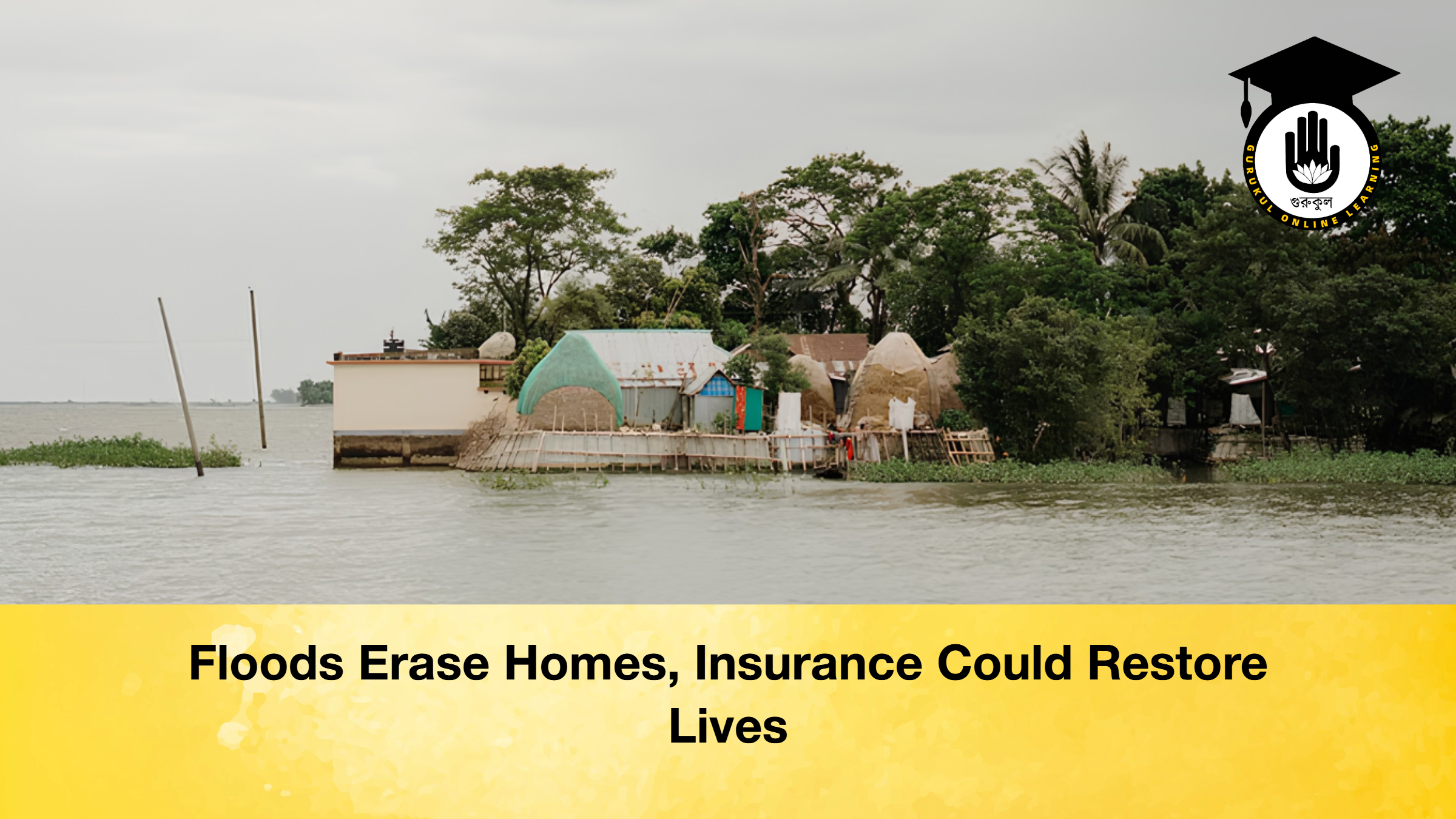
Flooding in Bangladesh is no longer viewed solely as a seasonal natural disaster. For millions of people living along the country’s rivers and low-lying areas, it represents one of the greatest financial risks to their livelihoods. Rising river levels inundate homes, wash away farmland, destroy crops, kill livestock and force small businesses to shut down. When the floodwaters eventually recede, many affected families are left confronting an even more difficult question: how to rebuild their lives with little or no financial support.
The economic impact of flooding extends far beyond the immediate emergency. A single flood can wipe out years of savings, valuable household assets and carefully built livelihoods. Despite Bangladesh’s high vulnerability to climate-related disasters, access to effective flood and climate risk insurance remains limited. As a result, countless households are forced to rely on emergency relief, high-interest loans or assistance from relatives to recover from devastating losses.
Experts argue that disaster management should not end with relief distribution and rehabilitation efforts. A stronger financial protection system is needed to help affected communities return to normal life more quickly. Flood insurance and climate risk insurance are increasingly being recognised as important tools that can reduce long-term economic hardship after disasters.
Flood-prone districts continue to face recurring threats
Communities living near Bangladesh’s major rivers have lived with flood risks for generations. Districts such as Kurigram, Gaibandha, Lalmonirhat, Jamalpur, Sirajganj and Sunamganj experience flood damage almost every year, affecting homes, agriculture and local economies.
During the 2026 monsoon season, several parts of the country have again come under flood threat. According to the Flood Forecasting and Warning Centre of the Bangladesh Water Development Board, flood risks have emerged in several river basins and low-lying areas. Authorities have warned of possible short-term flooding in parts of Bandarban, Cox’s Bazar, Feni, Chattogram and Khagrachhari while continuing to monitor water levels across the country’s major rivers.
Northern districts also remain under close observation as water levels in rivers including the Brahmaputra, Dharla and Dudhkumar fluctuate. Residents of riverine char areas in Kurigram fear renewed flooding that could damage homes, livestock and agricultural assets. Without adequate financial protection, recovery from such losses often becomes a prolonged struggle for affected families.
The Flood Forecasting and Warning Centre continues to issue regular updates on river levels, potential inundation areas and communities at risk, enabling local authorities and residents to prepare for possible flooding.
Heavy financial losses deepen poverty
Floods disproportionately affect low-income households because their assets are often limited to a modest home, small plots of farmland, a few livestock animals or a micro-business. A severe flood can destroy every one of these income-generating resources within days.
For farmers, flooding means not only losing standing crops but also losing seeds, fertiliser and working capital needed for the next planting season. Daily wage earners often find themselves without employment for weeks or even months as economic activities come to a halt. Small traders whose shops and inventories are damaged frequently struggle to restart their businesses because they lack sufficient capital.
River erosion creates an even more severe humanitarian challenge. Many families are permanently displaced after losing both their homes and agricultural land to riverbank collapse. Even after floodwaters subside, they are often unable to return to their original communities, increasing their risk of long-term poverty and displacement.
Insurance coverage remains limited
Although Bangladesh is widely recognised as one of the world’s most climate-vulnerable countries, insurance penetration remains low. The insurance sector contributes less than one per cent of the country’s gross domestic product, indicating that a significant portion of the population remains outside formal financial protection.
Several factors contribute to this situation, including limited public awareness of insurance, restricted access to insurance services in rural areas, the inability of many low-income households to afford premiums and the limited availability of specialised disaster-related insurance products.
Ironically, those facing the highest flood risks often have the least financial protection. Many families recovering from disasters are forced to borrow money at high interest rates or sell their remaining assets simply to survive.
Expanding agricultural and property insurance
Bangladesh has introduced agricultural, crop and property insurance products, but these services have yet to achieve widespread adoption. Experts believe future insurance schemes should be affordable, accessible and designed specifically for vulnerable communities exposed to recurring floods.
Insurance products tailored to the needs of farmers, fishermen, small entrepreneurs and low-income households could significantly reduce post-disaster financial hardship. Equally important is simplifying claims procedures so compensation reaches policyholders quickly when disasters occur.
Lessons from the devastating 2024 floods
The severe floods of 2024 highlighted the country’s vulnerability to climate-related disasters. Nearly 5.7 million people across 11 eastern districts were affected, with Feni, Cumilla, Noakhali, Lakshmipur, Brahmanbaria, Chattogram and Khagrachhari among the hardest-hit areas.
Thousands of families lost homes, farmland and livelihoods, while many endured prolonged financial hardship long after emergency assistance ended. The disaster reinforced the importance of developing financial risk protection mechanisms alongside conventional relief and rehabilitation programmes.
Climate change is intensifying flood risks
Flooding in Bangladesh is no longer driven solely by seasonal rainfall. Climate change is contributing to heavier rainfall, increased upstream water flows, changing river courses, sediment accumulation and rising sea levels, all of which are altering flood patterns across the country.
International studies suggest that extreme weather events are likely to become more frequent and more severe in the coming decades. This means Bangladesh must strengthen not only physical flood defences and emergency response systems but also financial resilience against climate-related disasters.
Parametric insurance offers a promising alternative
Many countries have introduced parametric insurance to improve disaster recovery. Unlike traditional insurance, which requires lengthy assessments of individual losses, parametric insurance provides compensation automatically when pre-defined triggers—such as rainfall intensity, river water levels or other measurable disaster indicators—exceed agreed thresholds.
This approach enables affected communities to receive financial support much more quickly, allowing households and businesses to begin rebuilding without prolonged claims processes. For disaster-prone countries like Bangladesh, parametric insurance could become an effective solution for protecting farmers, small business owners and vulnerable communities.
Beyond relief towards long-term resilience
Addressing Bangladesh’s growing flood risk requires coordinated efforts involving the government, insurance companies, development organisations and local institutions. Emergency relief will always remain essential during disasters, but long-term financial security demands broader access to effective insurance solutions.
Floodwaters eventually disappear, yet the loss of homes, crops, businesses and years of savings often leaves lasting economic scars. Recovering from those losses can take years.
Flood insurance should therefore be viewed not merely as another financial product but as a vital component of climate resilience. Rivers may continue to erode land, and floods may continue to destroy livelihoods, but a well-designed insurance system can provide families with the financial confidence and support needed to rebuild their lives after disaster.